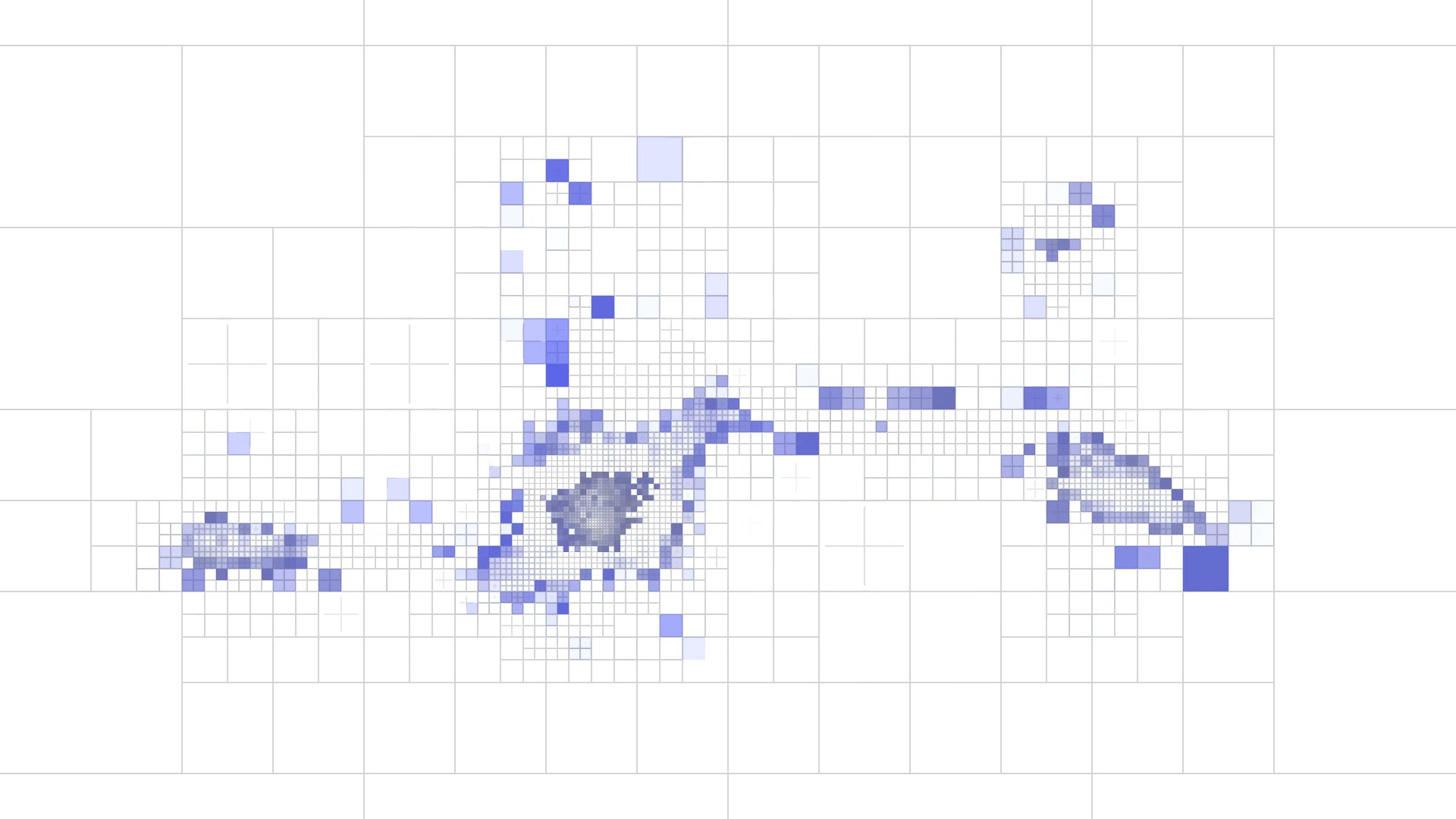
Living Systems is an ongoing body of computational work about the visual language of life: how simple local behaviours can become collective movement, structure and form. Drawing on my background in biomedical science and software engineering, I build artificial ecologies shaped by migration, reproduction, environmental pressure and time.
My motivation doesnt just come from biological aesthetics but from a desire to understand the systems underneath. I study how individuals respond to their surroundings, how populations form, and how small actions accumulate into events at another scale.
Building conditions, not images
The first system contains 28,000 individual agents governed by a small set of rules for seasonal migration and reproduction. Each agent responds to local conditions. None has any knowledge of the final composition, which only becomes visible at the scale of the population.
Rather than design a final image, I choose the behaviours, constraints, starting conditions, duration and point of view. As stable behaviours emerge the beauty of the system is discovered as a conversation between myself and the system I’m building, without a clear destination in mind.
The final artwork is a record of a minutae building and changing over time, captured and studied.
An evolving body of work
Living Systems is not a single finished piece. It is the beginning of a longer body of work that will grow through simulations, moving-image studies and experiments in artificial ecology. I will also keep adding process notes, failed attempts and changes in direction. I want the development of the system to remain visible alongside the finished work.
The work is guided by a set of open questions:
- How little behaviour is needed before a system starts to feel alive?
- How can seasons and lifecycles be made visible without turning the work into a diagram?
- When does repeated behaviour begin to register as collective behaviour?
- What does it mean to compose an image when I can shape its possibilities but not determine its final form?
- Can this work inform our intuitive understanding of how individuals become a collective consciousness.
Study 001 — Seasonal Migration and Reproduction is the first public sharing of the project.
A line through the practice
Living Systems follows a line through my earlier generative work. Organised Reality began with an existing image and reorganised its rows. Fragments ran one shader program across a field until it felt like a world. Explorations in Vellum used constraints, pressure, collision and force to make forms I would not have designed directly.
Those projects moved from transforming an image, to repeating a rule, to letting interacting forces determine form. Living Systems takes that progression further. The unit is no longer the pixel, vertex or surface. It is the individual, and the image is the trace of a population.